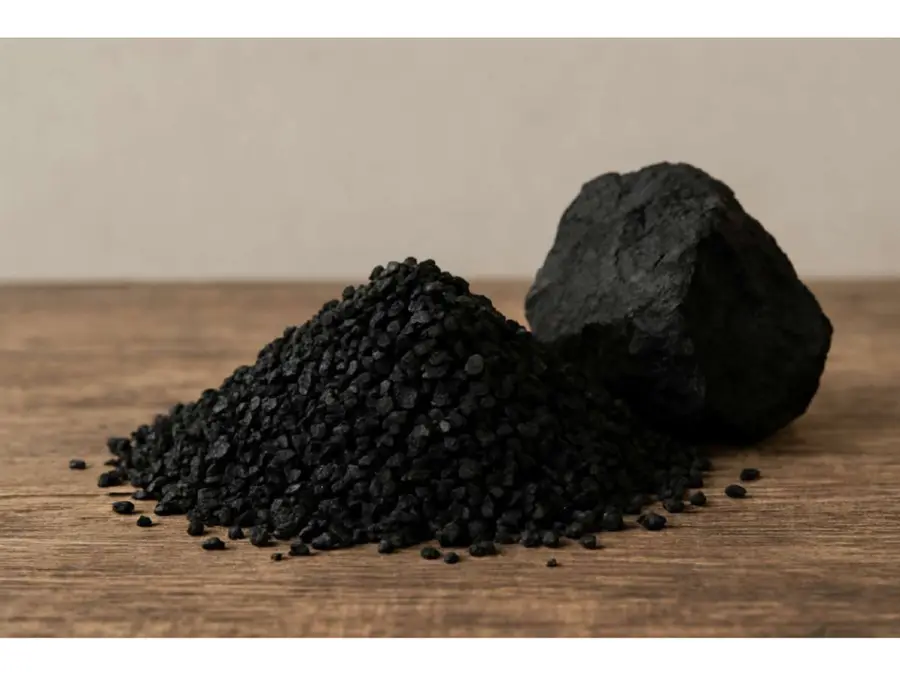
The short version: choose coconut shell carbon for small molecules, hard-wearing beds and clean duty like drinking water and gold, and choose coal based carbon for larger colour and odour molecules, heavy wastewater and jobs where the bigger pores do the work. The deciding factors are the size of the molecule you are removing, how much mechanical punishment the carbon takes, and how clean the final water has to be. Everything else is detail on top of those three.
The pore structure is the whole difference
Both carbons are mostly empty space inside, but the space is shaped differently, and that comes straight from the raw material. Coconut shell is dense and uniform, so it activates into a carbon dominated by micropores, the smallest size class. Coal is more varied, and depending on the type it activates into a carbon with a broader spread of pore sizes, including more of the medium and larger pores. Think of coconut as a sponge full of very fine holes and coal as a sponge with a mix of fine and coarse ones. Neither is better in the abstract. They are better at different molecules.
Molecule size decides most of it
A molecule only adsorbs if it fits the pore. Small molecules such as chlorine and low molecular weight organics slot neatly into coconut’s micropores, which is why coconut dominates potable water polishing and chlorine removal. Larger molecules, the big colour bodies in a dark effluent or heavy odour compounds, cannot enter the smallest pores at all, so they need coal’s wider pore openings to get inside and stick. Try to decolourise a heavy wastewater with a pure micropore coconut carbon and it underperforms, not because it is low quality but because the molecule never fits. Match the pore to the molecule and the grade chooses itself.
Hardness and attrition
Coconut shell carbon is the harder of the two, and in some applications that decides everything. Any bed that is backwashed regularly, and any circuit where the carbon is agitated, punishes a soft carbon by grinding it into fines that wash away and take adsorption capacity with them. Coconut resists that. It is why gold recovery runs almost exclusively on coconut carbon, where the grains tumble with abrasive slurry and only a hard carbon survives, a point we go into in the gold recovery guide. For a gently operated bed the difference matters less, but wherever there is mechanical stress, hardness tips the choice toward coconut.
Purity and ash
Coconut shell carbon typically carries lower ash and a cleaner mineral profile, which is why it is favoured for drinking water, food and pharmaceutical duty where you do not want the carbon leaching anything back into the product. Coal based carbon generally runs higher ash. That is perfectly acceptable for industrial wastewater and many process streams, but it is a reason coconut tends to win the potable and food-contact jobs. If the carbon is touching something a person will drink or eat, the cleaner coconut profile is usually worth it.
The sustainability angle, honestly
Coconut shell is an agricultural byproduct. The shell is a waste stream from coconut processing, so turning it into carbon uses something that would otherwise be discarded, and the crop renews every year. Coal is mined and finite. For buyers who weigh the source of their materials, that is a real point in coconut’s favour. It is not a reason to put coconut where coal belongs, but where the two would perform similarly, the renewable feedstock is a fair tiebreaker.
A simple way to decide
Run your duty through a few plain questions and the answer usually falls out.
- Removing small molecules, chlorine, light organics, or recovering gold? Coconut shell.
- Removing large colour or odour molecules from a heavy effluent? Coal based.
- Is the carbon backwashed hard or agitated in a circuit? Lean coconut for the hardness.
- Does the water or product have to be food or drinking grade? Lean coconut for the cleaner ash.
- High-organic industrial wastewater on a tight budget? Coal based earns its place.
When a duty lands in between, the best move is not to argue theory, it is to sample both against your own stream and measure. We make both grades, so the comparison is not a sales pitch for whichever one we happen to stock. Sometimes the answer is a coconut carbon, sometimes a coal one, and occasionally the honest answer is a blend or a powder dosed ahead of a bed.
Where wood based carbon fits
Coconut and coal are the two you will weigh most often, but there is a third feedstock worth knowing, because sometimes it is the right answer. Wood based activated carbon has a very open pore structure skewed toward the larger pores, which makes it a strong decolouriser, excellent at pulling big colour bodies out of sugar syrups, edible oils and similar liquids. Its weakness is hardness; wood carbon is softer than coconut and often softer than coal, so it belongs in a dosed powder and gentle duty rather than a hard-backwashed bed or a tumbling circuit. If your problem is colour in a liquid and mechanical stress is low, wood based carbon, usually as a powder, can beat both of the others.
You do not always have to choose one
Framing it as coconut against coal can hide the fact that real plants often use more than one carbon in sequence. A high-organic wastewater might run through a coal based bed to take out the bulk of the large molecules, then a coconut polish to catch what is left. A liquid might get a powder dose to knock down a colour spike ahead of a granular bed that handles the steady load. The grades are tools, and a treatment train is allowed more than one. When a single carbon is being asked to do two very different jobs and doing neither well, the answer is usually to stage two grades rather than keep hunting for one that does everything.
Frequently asked questions
Which is better, coconut shell or coal based activated carbon?
Neither in the abstract. Coconut suits small molecules, hard-wearing beds and clean potable or food duty. Coal suits larger colour and odour molecules and heavy wastewater. The right one is the one whose pores fit your contaminant.
Why is coconut shell carbon used for drinking water?
Its micropores are sized for the small molecules in potable water such as chlorine and light organics, it is hard enough to survive backwashing without shedding fines, and its lower ash keeps the treated water clean.
The coconut versus coal question only sounds like a contest. In practice it is a matching exercise: find the molecule, note how rough the service is, check how clean the output must be, and the grade is decided. The useful supplier is not the one who insists their carbon does everything, it is the one who makes both and will tell you, with a sample to prove it, which one your process actually wants.

Need help choosing a grade?
Tell us your specification and we will match the right material and share a quote.