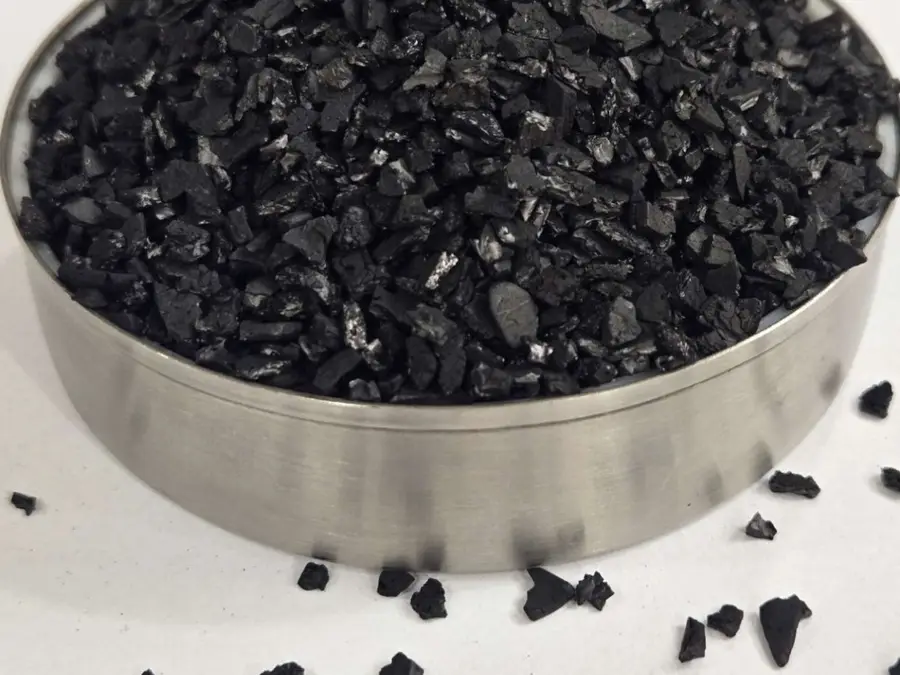
There is no single carbon called water treatment grade. The right choice depends entirely on what you are trying to remove and how your plant is built. Chlorine and taste and odour want a high-activity coconut carbon. A heavy organic or colour load in effluent wants a coal based carbon with bigger pores. A seasonal spike wants powder you can dose and walk away from. Pick by the contaminant first and the hardware second, and the grade almost chooses itself.
What activated carbon actually removes from water
Carbon works by adsorption, which means dissolved molecules stick to its internal surface. It is very good at the things that make water taste, smell and look wrong: free chlorine, chloramine, dissolved organics, many pesticides and industrial solvents, and the compounds behind most taste and odour complaints. It is the standard polishing step ahead of reverse osmosis because it protects the membrane from chlorine.
It is just as important to know what carbon does not do. It will not soften water, it will not pull out dissolved salts, nitrates or fluoride to any useful degree, and it is not a disinfectant. Buyers who expect carbon to fix hardness or TDS are shopping for the wrong product. Carbon is for the dissolved organic and chlorine load, and it is excellent at that.
Iodine number, explained properly
Iodine number is the figure you will see quoted on nearly every water carbon, and it is worth understanding rather than just chasing. It measures how many milligrams of iodine a gram of carbon can adsorb, tested to the method ASTM D4607. Because the iodine molecule is small, that figure is a proxy for the volume of small pores in the carbon, and small pores are where most dissolved contaminants in water get caught. A higher iodine number generally means more adsorption capacity for small molecules.
Generally is the operative word. For demanding potable duty you want a figure around 1000 or above, and our coconut grades run from 1000 to 1200 mg/g. But higher is not automatically better. If your contaminant is a large colour or odour molecule, it cannot fit the smallest pores at all, and a carbon chosen purely on a headline iodine number will disappoint. Iodine tells you about capacity for small molecules. Match it to molecule size, not to the biggest number on the page.
Granular beds or powder dosing
Granular carbon sits in a fixed bed and water flows through it continuously, the right answer for steady, year-round removal. Powdered carbon is dosed into the water, mixes, adsorbs fast and is then settled or filtered out, the right answer for intermittent or seasonal loads. We cover the trade off in detail in the powdered carbon guide; for most municipal and industrial plants with a constant duty, a granular bed is the workhorse.
Coconut or coal for water
For clean potable polishing, chlorine removal and point-of-use filters, coconut shell carbon and its micropores are the standard. For municipal wastewater, high-colour effluent and streams carrying larger organic molecules, a coal based carbon earns its place because its wider pores reach molecules coconut cannot. The full comparison is worth a read before you specify, because this one decision changes your bed life and your running cost.
The specs to put on the purchase order
- Iodine number, set to your contaminant, commonly 1000 or above for potable duty.
- Mesh, commonly 8x16 or 12x40 for granular beds, chosen for your flow and pressure-drop budget.
- Ash content kept low, under about 5 percent for drinking water, so you are not leaching minerals back in.
- Moisture controlled, so you pay for carbon, not water.
- Hardness high enough to survive repeated backwashing without shedding fines.
Contact time is the spec nobody writes down
The best carbon in the world fails if the water does not stay in contact with it long enough. The practical measure is empty bed contact time, the time a parcel of water spends passing through the carbon. Undersize the bed or overrun the flow and even a high-iodine carbon will let contaminants slip through, not because the carbon is weak but because the water never touched enough of it. When a bed underperforms, check the contact time before you blame the carbon. Very often the carbon is fine and the bed is being pushed too hard.
Carbon is one layer, not the whole filter
In most treatment trains carbon is doing the chemistry while a separate layer does the physical straining. That straining layer is usually anthracite media, which catches the suspended solids before they ever reach and blind the carbon. The two are different materials doing different jobs, and confusing them is a common and expensive mistake. If your water carries turbidity, you need both, and the anthracite guide explains where it sits.
How to tell when a carbon bed is exhausted
Carbon does not fail loudly. It saturates gradually, and the first sign is breakthrough, the point where the contaminant starts appearing in the treated water because the carbon can no longer hold it. For chlorine removal, a simple chlorine test on the outlet tells you at once: the day free chlorine shows up downstream, the bed is spent for that duty. For taste and odour, the complaints tend to return before any instrument notices. The useful habit is to monitor the outlet, not just the inlet, and to log it, so you watch the trend toward breakthrough arrive instead of being ambushed by it.
Bed life depends on the contaminant load, the flow and the carbon, so there is no universal change interval. What matters is that you change on evidence rather than on a calendar or a guess. A bed swapped too early throws away good carbon; one swapped too late lets contaminated water through.
Regenerate or replace
When a granular bed is spent you have two routes. Large operations often send the carbon for thermal reactivation and return it to service, spreading the cost over several lives. Smaller plants usually just replace the charge, because the logistics of reactivating a small quantity rarely pay. Which route suits you is a volume and logistics question more than a technical one, but it is worth deciding before the bed exhausts rather than scrambling when it does.
Frequently asked questions
What does activated carbon remove from water?
Chlorine, chloramine, dissolved organics, many pesticides and solvents, and the compounds behind taste, odour and colour. It does not remove hardness, dissolved salts, nitrate or fluoride to a useful degree, and it is not a disinfectant.
What iodine number do I need for water treatment?
Around 1000 or above for demanding potable duty, but match it to your contaminant. Small molecules want a high iodine coconut carbon; large colour and odour molecules want a coal based carbon with wider pores regardless of the iodine figure.
Water treatment rewards the buyer who thinks in terms of a specific contaminant and a specific flow rather than a generic grade. Name the molecule, size the contact time, and specify the carbon that fits it. Do that and the bed runs long, the water comes out right, and the carbon stops being a mystery line on the maintenance budget.

Need help choosing a grade?
Tell us your specification and we will match the right material and share a quote.