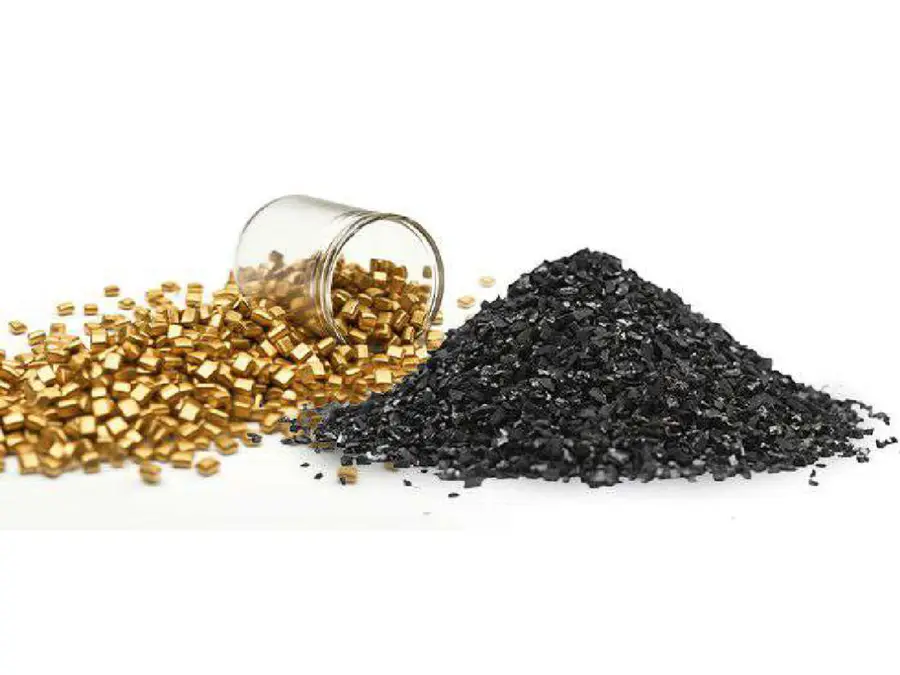
Gold recovery runs on hard coconut shell granular carbon, almost always in a 6x12 mesh. The carbon pulls dissolved gold out of a cyanide leach solution and holds it until you strip it back off in a concentrated form. Two properties decide whether a carbon does that job well: its activity, which sets how much gold it can load, and its hardness, which sets how long it survives the mill before it abrades into useless fines. Get either wrong and you literally wash gold down the drain.
How carbon pulls gold out of solution
In a cyanide leach the gold dissolves as a gold cyanide complex. Activated carbon has a strong affinity for that complex, so when you contact loaded solution with carbon, the gold adsorbs onto the carbon surface and the barren solution moves on. Once the carbon is loaded, you reverse the process in an elution or stripping circuit, using hot caustic cyanide to drive the gold back off into a small, rich solution you can electrowin or precipitate. The carbon is then reactivated and sent back round. It is a shuttle, not a consumable, which is why durability matters so much.
CIP, CIL and CIC: where the carbon sits
The three circuits differ only in where the carbon meets the ore relative to leaching.
In Carbon in Pulp, the ore is leached first in dedicated tanks, then the pregnant pulp flows into separate tanks where carbon adsorbs the gold. Leaching and adsorption are two steps in sequence.
In Carbon in Leach, the carbon is added into the leach tanks themselves, so the gold is adsorbed almost as fast as it dissolves. This suits ores with preg-robbing material that would otherwise steal dissolved gold, because the carbon competes for it in real time.
In Carbon in Column, clarified solution with very few solids is passed up through columns of carbon, typical of heap leach operations. With little abrasive solid around, column carbon leads an easier life than carbon tumbling in a pulp tank.
Why hardness is non-negotiable
This is the point most buyers underrate. In a pulp circuit the carbon is agitated for days with sand-grade solids. Every collision chips the grain. A soft carbon rounds off, sheds fines, and those fines float out of the screens carrying their loaded gold with them. The loss is invisible until you do the accounting and find your recovery has quietly slipped. A hard coconut shell carbon resists that attrition, holds its mesh, and stays in the circuit where it belongs. There is no substitute and no clever workaround. The carbon has to be hard, and coconut shell is what gets you there, for reasons we explain in the coconut shell carbon guide.
The specs that matter for a gold carbon
- Hardness or abrasion number as high as you can get, commonly specified above 95, because this is your attrition insurance.
- Activity, read through iodine number and gold-specific adsorption tests, so the carbon loads enough gold per tonne to be worth circulating. Our gold grade runs at 1050 to 1150 mg/g iodine.
- Mesh, usually 6x12, coarse enough to screen cleanly from the pulp yet fine enough for fast kinetics.
- Low fines content as delivered, so you are not starting with the very material you are trying to avoid generating.
- Platelet-free, dense grains that reactivate well, because the carbon has to come back from the kiln ready to work again.
Carbon management is an ongoing cost, not a one-off buy
A gold plant does not buy carbon once. It tops up to replace what attrition and reactivation losses take out each cycle. That means the number that governs your real spend is not the quote on the first tonne, it is how slowly the carbon wears out. A harder carbon with a lower attrition rate means fewer top-ups, fewer gold-bearing fines lost, and a steadier circuit. Over a year that gap dwarfs any difference in the purchase figure. Judge a gold carbon on cost per cycle survived, not cost per bag.
Elution and reactivation: closing the loop
Loading gold onto carbon is only half the circuit. Once a batch is loaded it moves to elution, where hot caustic cyanide solution strips the gold back off into a small, concentrated stream that goes to electrowinning or precipitation. The now-barren carbon is thermally reactivated in a kiln, which burns off organic foulants and restores most of its original activity, and it returns to the adsorption stage to load again. A single parcel of carbon can go round this loop many times. That reuse is the economic heart of the process, and it is why durability and reactivation behaviour matter as much as fresh activity.
Every pass costs the carbon a little. Some is lost to attrition, some activity is never fully recovered, and a fraction is screened out as fines. A hard coconut carbon loses less at each step, which is why it dominates circuits that reactivate carbon continuously. A carbon that comes back from the kiln near its original number is worth far more over a year than one that drops a step with every cycle.
Where gold carbon goes wrong
Most carbon-related losses in a gold plant trace back to a handful of avoidable choices. Substituting a cheaper, softer carbon to save on the purchase is the classic one, and it shows up months later as a quiet slide in recovery once the soft carbon has ground itself into gold-bearing fines. Undersized or damaged screens let those fines escape instead of catching them. Shortcutting the acid wash lets carbonate and other foulants build up and blind the carbon so it loads less each cycle. None of these is dramatic on the day. They are slow leaks, and a hard carbon run with a disciplined management routine plugs most of them.
What a gold plant should ask a carbon supplier
Beyond the headline activity, press on the things that govern cost per cycle. Ask for the abrasion or hardness number and the method behind it, the fines content as delivered, how the carbon behaves through repeated reactivation, and whether they can supply consistently at the tonnage a circuit burns through in top-ups. A supplier who answers those crisply has sold carbon to gold plants before. One who quotes only iodine and a figure has not.
Frequently asked questions
Which activated carbon is best for gold recovery?
A hard coconut shell granular carbon in 6x12 mesh with high activity and high abrasion resistance. Coconut shell is the industry standard because it combines the micropore activity that loads gold with the hardness that survives a leach circuit.
What is the difference between CIP and CIL?
In CIP, leaching finishes before the carbon is introduced. In CIL, the carbon sits in the leach tanks and adsorbs gold as it dissolves, which helps with preg-robbing ores. The carbon grade itself is usually the same.
Why does carbon hardness matter so much in gold plants?
Soft carbon abrades into fines under agitation, and those fines escape the screens carrying adsorbed gold, lowering recovery. Hard carbon stays intact and stays in the circuit.
Everything in a gold circuit is designed to keep the gold inside it. The carbon is the net. A hard, active coconut carbon is a net that does not tear, and in a business where a fraction of a percent of recovery pays for a lot of carbon, that is the only kind worth running.

Need help choosing a grade?
Tell us your specification and we will match the right material and share a quote.