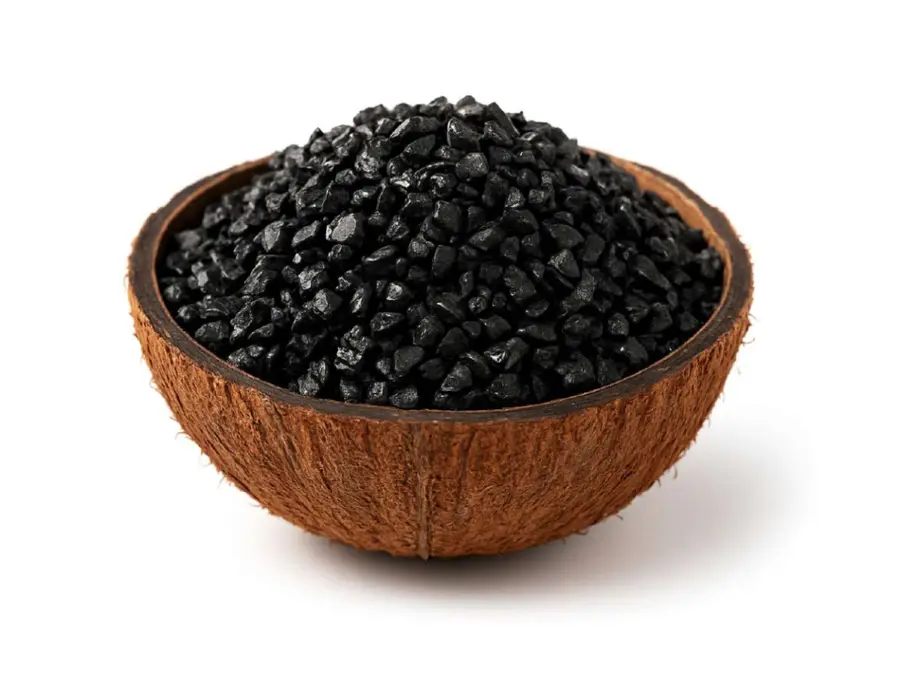
Coconut shell makes the hardest, most microporous activated carbon you can buy, and that single fact explains why it dominates potable water, gold recovery and solvent work. The shell starts dense and fibre-free, so when you carbonise and activate it, you get a carbon packed with tiny pores and tough enough to survive years of backwashing. Here is what actually happens between a discarded shell and a sack of carbon, and why each step shows up later in how the carbon performs.
From shell to char to carbon
Production runs in two stages. First the shells are carbonised, heated without much air so the volatile matter cooks off and you are left with a hard char that is mostly carbon. Second, that char is activated. We raise it to high temperature and pass superheated steam through it. The steam reacts with the carbon and burns out a network of internal channels, opening up the enormous internal surface area that does the adsorbing. Nothing is added. The pores are carved out of the carbon itself, which is why a well-activated coconut carbon is clean enough for drinking water and food contact.
The degree of activation is a dial. Push it further and you open more pore volume and lift the iodine number, but you also burn away yield and start to soften the grain. Holding that balance is the craft, and it is where a manufacturer who runs the kiln beats one who buys finished carbon and hopes.
Micropores are where the small molecules get trapped
Adsorption is a size game. A molecule sticks to the carbon when it finds a pore it fits snugly inside. Coconut shell carbon is dominated by micropores, the smallest class, which is exactly the size range that catches chlorine, low molecular weight organics, and the dissolved gold complex in a leach circuit. That is why coconut outperforms almost everything on those duties and why it is the default when the target molecule is small.
The number that tracks this is the iodine value. Iodine molecules are small, so how much iodine a carbon adsorbs is a reliable proxy for its micropore volume. Our coconut grades sit between 1000 and 1200 mg/g. If you want the full explanation of what iodine number does and does not tell you, we cover it in the water treatment guide; for coconut carbon, read a high iodine figure as a well-developed micropore network.
Hardness you can feel
Pick up coconut carbon and it rattles like gravel. Pick up a softer carbon and you see dust. That hardness is not cosmetic. In a filter bed the grains are scoured against each other every backwash, and in a gold circuit they tumble with abrasive ore slurry. A soft carbon abrades into fines, blinds the bed or washes out of the circuit, and takes your adsorption capacity with it. Coconut shell carbon resists that. It is the reason the grade is specified wherever the carbon has to take mechanical punishment, which we unpack in the gold recovery guide.
Where coconut shell carbon earns its place
- Potable water polishing, where you want chlorine, taste and odour gone and the carbon clean enough to drink through.
- Gold recovery, where micropore activity and hardness both matter at once.
- Air and gas phase work, including VOC and odour control, often in pellet or granular form.
- Solvent recovery, where the small-pore structure grips light solvent vapours.
- Point-of-use and cartridge filters, where a little hard carbon does a lot.
The grades and mesh we produce
Mesh is just particle size, and it matters because it sets the pressure drop and the contact kinetics in your bed. Finer grains adsorb faster but resist flow more. We produce coconut shell granular carbon across the common water and gas meshes, including 4x8, 8x16, 12x40 and 20x40, with iodine bands chosen to match the duty. Packing runs from 25 and 50 kilogram bags up to 500 and 1000 kilogram jumbo bags and bulk, lined where moisture is a risk.
Tell us the contaminant, the flow rate and the vessel, and the mesh and iodine follow from there. That is the right order to make the decision in. Choosing a mesh first and forcing the application onto it is how beds end up either starved of contact time or choking on pressure drop.
Coconut is not always the answer
Honesty sells better than a one-grade pitch. If your target is a large colour body or a heavy wastewater organic, coconut micropores are too small and a coal based carbon with bigger pores will outperform it. We make that carbon too, and the comparison between the two is worth reading before you commit a budget. Coconut is the right default for small molecules and clean duty. It is not a universal carbon, and anyone telling you it is has one thing to sell.
Activated carbon is not barbecue charcoal
A surprising number of enquiries begin from a genuine confusion, so it is worth settling. The lump charcoal in a barbecue is wood that has been carbonised and nothing more. It has some porosity but almost none of the engineered internal surface that defines activated carbon. Coconut shell activated carbon goes through the second step, high-temperature steam activation, which carves out the dense micropore network and multiplies the usable surface area enormously. The names sound alike and the colour is the same, but one filters drinking water and holds gold in a mill, and the other cooks dinner. When a price looks too good for activated carbon, there is a fair chance you are being quoted plain charcoal.
Built to be used more than once
That hardness pays off at the end of the carbon’s first life as well as during it. Because the grains resist abrasion, they come through thermal reactivation better than softer carbons, returning from the kiln with most of their structure intact and ready for another cycle. For an operation that reactivates spent carbon rather than throwing it away, that durability is the gap between a grade that reuses well for years and one that crumbles the first time it is regenerated. It is one more reason the hard coconut grain earns its keep wherever carbon is treated as an asset to manage, not just stock to consume.
Reading a coconut carbon datasheet
Four figures carry most of the meaning. Iodine number for the micropore activity, hardness for how well the grain survives service, ash for how clean it is, and moisture for how much of the weight is carbon rather than water. A strong potable-grade coconut carbon shows a high iodine number, a hardness up in the high nineties, low ash and controlled moisture. If a datasheet quotes only one of those, usually a flattering iodine figure on its own, ask for the rest. The number a supplier leaves off is often the one worth seeing.
The shell does the hard work here. A good manufacturer just gets out of its way, carbonising and activating carefully enough to turn an agricultural leftover into a carbon that can clean your drinking water or hold gold in a mill. Everything downstream, the iodine number, the hardness, the clean ash figure, traces back to that raw material and a steady hand on the kiln.

Need help choosing a grade?
Tell us your specification and we will match the right material and share a quote.