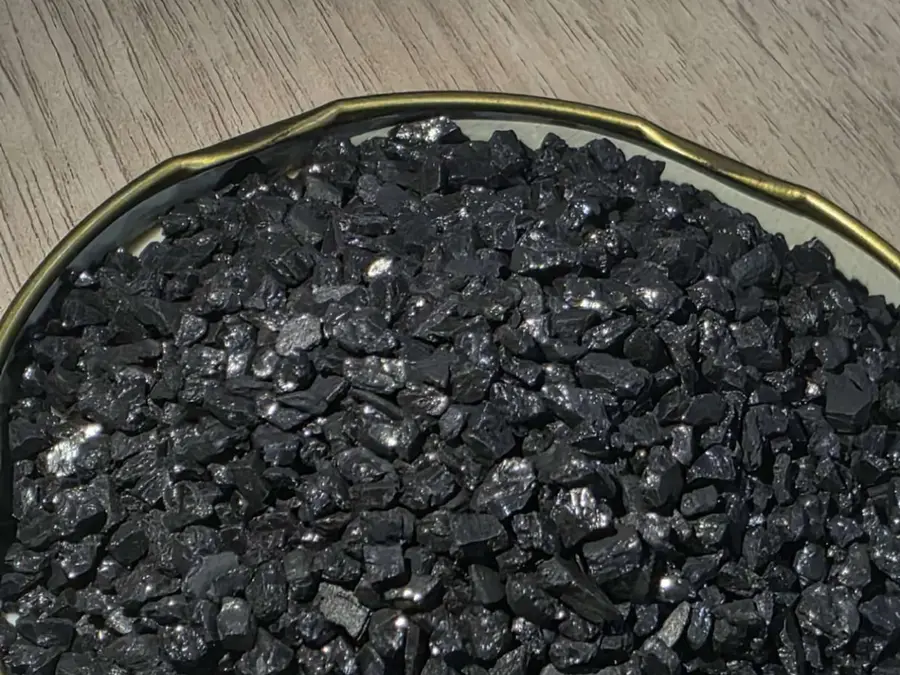
Anthracite filter media and activated carbon get confused constantly, and the confusion costs people money. They are different materials doing different jobs. Anthracite is a filtration medium: hard, angular black granules that physically strain suspended solids out of water as it flows through a bed. It does not adsorb dissolved molecules the way carbon does. If you need to clear turbidity and suspended matter, anthracite is your material. If you need to remove something dissolved, you need carbon. Knowing which problem you have is the whole decision.
Filtration is not adsorption
This is the distinction everything else hangs on. Adsorption is chemistry: dissolved molecules stick to the vast internal surface of activated carbon. Filtration is mechanics: particles too big to pass between the grains get trapped as water flows through. Anthracite does the second. It has very little internal surface area, so it will not touch chlorine, taste, odour or a dissolved organic. What it does superbly is catch the floc, rust, silt and suspended solids that would otherwise cloud your water or clog whatever comes next. Use anthracite to make water clear, use carbon to make it clean, and never expect either to do the other one.
Why anthracite beats plain sand
The traditional filter medium is sand, and anthracite replaces or tops it for good physical reasons. Anthracite grains are angular and irregular rather than rounded, so they pack with more open space between them. That gives a higher porosity, usually in the range of 45 to 55 percent, which means the bed can hold far more trapped dirt before it blocks. The practical results are longer filter runs between cleans, lower head loss as water passes through, and less backwash water wasted. A bed that would blind on sand keeps running on anthracite.
The material itself is well defined. Good filter anthracite runs a Mohs hardness around 3.0 to 3.5, a specific gravity between roughly 1.40 and 1.60, and a bulk density near 0.80 to 0.90. Those numbers are not trivia. The hardness means the grains survive backwashing without rounding off, and the lower specific gravity compared with sand is exactly what makes dual-media beds work.
Dual-media and multi-media beds
Here is the clever part. Because anthracite is lighter than sand, you can layer it on top. After a backwash, the coarser, lighter anthracite settles above the finer, denser sand, giving you a bed that is coarse at the top and fine at the bottom. Water enters the coarse layer first, where the big particles are caught in the open spaces, then meets the fine sand which polishes out the smaller ones. The whole depth of the bed does work instead of just the top skin, which is what blinds a single-medium sand filter so quickly. Add a layer of dense garnet underneath and you have a multi-media bed that filters finer still.
Where it fits in the treatment train
Anthracite filtration sits early, before the sensitive and expensive steps. It protects carbon beds from being clogged by solids, and it protects reverse osmosis membranes from fouling. Suspended solids that reach a carbon bed blind the carbon and waste its adsorption capacity on the wrong job. Strain them out first with anthracite and the carbon lasts far longer, which ties straight into how a water treatment train should be sequenced.
The specs a good media is judged on
- Effective size, the grain size that controls how fine the filtration is.
- Uniformity coefficient, kept low so the grains are a consistent size and the bed grades cleanly on backwash.
- Hardness, high enough that grains do not round off or break down in service.
- Acid solubility, kept low so the media does not dissolve or leach in treated water.
- Low moisture and insolubles, with a clean, low-dust final product. Ours runs below 2% moisture and below 1.5% insolubles.
Calcined anthracite is a different animal
One thing worth clearing up, because the names blur. Calcined anthracite is not the same as filter media. It is anthracite that has been heat treated to drive off volatiles and raise its fixed carbon to around 90 to 95 percent, with low ash and sulphur. That high-carbon product is used mainly as a carbon raiser in steel-making and foundries, and as a carbon additive and in electrodes. Filter-grade anthracite is a lower fixed carbon material selected for its physical filtration behaviour, not its carbon content. Same rock family, two different products, so specify which one you actually need.
Loading and backwashing a dual-media bed
A dual-media bed only works if it is commissioned properly, and the commissioning is mostly about the backwash. You load the sand first, then the anthracite on top, but it is the backwash that actually grades them. A strong upward flow fluidises the whole bed and lifts the grains, and as the flow stops the denser sand settles first with the lighter anthracite settling above it, sorting itself coarse over fine. Get the backwash rate right and the two layers stay cleanly separated. Get it wrong and the media intermixes, or the lighter anthracite washes out of the top of the vessel.
You also leave freeboard, empty space above the media, so the bed can expand during backwash without losing grains over the outlet. A well-run filter is backwashed before head loss climbs too high, long enough to carry the trapped dirt away but not so hard that it ejects media. These are small operational details, and they are the difference between a filter that runs for years and one that quietly degrades.
Protecting membranes and resin downstream
In reverse osmosis and demineralisation plants, anthracite filtration usually sits right at the front for a specific reason: suspended solids are murder on the expensive stages that follow. A speck of floc that reaches an RO membrane fouls it, and fouled membranes mean more cleaning, more energy and shorter life. An ion-exchange resin bed clogged with silt channels and underperforms. A properly graded anthracite filter strips that turbidity out first, cheaply, so the costly downstream equipment only ever sees clear water. It is the least glamorous unit in the plant and one of the most protective.
Frequently asked questions
Is anthracite the same as activated carbon?
No. Anthracite is a filtration medium that physically strains suspended solids. Activated carbon adsorbs dissolved molecules. They are often used in the same plant but at different stages for different jobs.
Why use anthracite instead of sand?
Anthracite grains are angular and more porous, so the bed holds more dirt, runs longer between backwashes, and loses less head. Being lighter than sand, it also layers on top to form dual-media beds that use the full depth of the filter.
Anthracite is the unglamorous layer that makes everything downstream work. It does not clean water in the chemical sense, it clears it, and it does that cheaply and for a long time between services. Get the physical specs right, stack it correctly over your sand, and it quietly protects the expensive parts of your plant for years.

Need help choosing a grade?
Tell us your specification and we will match the right material and share a quote.